About the Journal
The Frontier in Sustainable Agromaritime and Environmental Development Conference (FiSAED) 2026, organized by the Directorate of Strategic Studies and Academic Reputation, IPB University, Indonesia, continues its commitment to advancing sustainable agromaritime development under the theme “From Innovation to Impact: Accelerating Science-Based Solutions for Sustainable Agromaritime Futures.” Building on the collaborative and innovation-driven spirit of previous FiSAED conferences, FiSAED 2026 emphasizes the translation of scientific knowledge, technological advancement, and interdisciplinary research into practical solutions that generate measurable and lasting impacts for society and the environment. As global challenges such as climate change, biodiversity loss, environmental degradation, resource scarcity, socio-economic inequality, and the growing demand for resilient production systems become increasingly interconnected, the conference highlights the need to move beyond scientific discovery toward meaningful implementation. FiSAED 2026 therefore provides a platform for researchers, policymakers, industry leaders, practitioners, and communities to exchange knowledge and accelerate the application of research and innovation in policy, industry, community practices, and scalable solutions. The conference will showcase interdisciplinary and science-based approaches across agriculture, fisheries, aquaculture, forestry, environmental management, and related agromaritime systems, with particular attention to emerging technologies, climate adaptation and mitigation, circular and regenerative practices, sustainable natural resource management, socio-economic innovation, environmental and ecosystem health, and community-based solutions. By connecting scientific evidence with real-world needs, FiSAED 2026 seeks to strengthen the interface between research, policy, business, and society while encouraging solutions that are locally relevant, globally connected, and capable of being replicated or scaled.
FiSAED 2026 is a continuation of the 2023, 2024, and 2025 conferences. It aims to attract more than 200 paper submissions, with international contributions projected to reach 30%. The table below summarizes the key information from the previous FiSAED conferences.
|
Conference Name |
Date |
Numbers of Paper |
Proceedings Link |
|
FiSAED 2023 |
Dec 14-15, 2023 |
145 Papers |
|
|
FiSAED 2024 |
Dec 19-20, 2024 |
74 Papers |
|
|
FiSAED 2025 |
Dec 18-19, 2025 |
75 Papers |
By fostering collaboration, encouraging joint authorship, and supporting global alliances, FiSAED cultivates a dynamic environment for knowledge sharing and innovation across disciplines. These partnerships are instrumental in driving systemic change, building resilient communities, and promoting the sustainable management of natural resources—key steps toward achieving broader sustainable development goals.
Further information regarding the scope of each subtheme is provided below:
|
Sustainable Natural Resources and Environmental Management |
Science and Technology for Sustainable Agromaritime |
|
|
|
Environmental Health and Ecosystems |
Socio-economic Transformation for Sustainable Agromaritime |
|
|
Current Issue
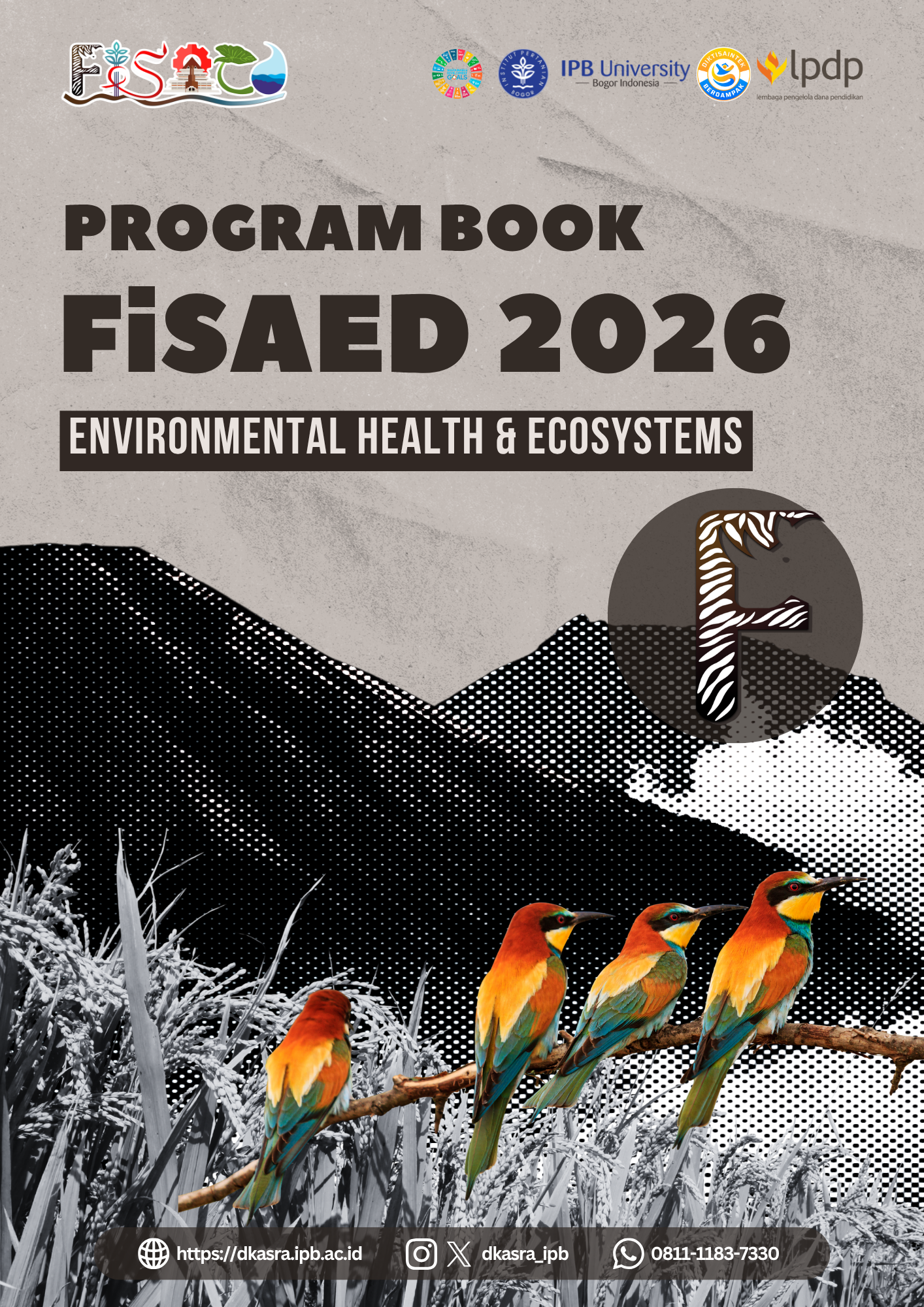
The Environmental Health and Ecosystems subtheme highlights the interconnection between environmental conditions, ecosystem integrity, and human and animal health in supporting sustainable agromaritime development. It covers five focus areas: (1) Environmental Medicine, examining the effects of environmental factors on health and disease; (2) Environmental Pollution and Hazards, addressing risks associated with pollutants, toxic substances, and environmental degradation; (3) Epidemiology and Tropical Diseases, investigating disease patterns, transmission, and environmental drivers in tropical regions; (4) Human and Animal Health, promoting integrated approaches to improve health and resilience across human and animal populations; and (5) Ecology, Biodiversity and Conservation, strengthening ecosystem protection, biodiversity conservation, and ecological resilience. Together, these areas support science-based solutions for healthier communities, animals, and ecosystems. Closely aligned with:


This emphasises the necessity for collaborative, multidisciplinary approaches to mitigate environmental hazards and preserve the delicate equilibrium that supports health across species and ecosystems.

This work is licensed under a Creative Common Attribution-Author 4.0 International License.
This license enables reusers to distribute, remix, adapt, and build upon the material in any medium or format, so long as attribution is given to the creator. The license allows for commercial use.