









ABOUT THE CONFERENCE
"Autonomous Social Sciences and Alternative Development in Times of Multiple Crises"
May 21-23th 2026 | IPB University, Bogor, Indonesia | Hybrid Format
Navigating the Poly-Crisis: A Regional Imperative
The Asia-Pacific region currently stands at the precipice of a severe ‘poly-crisis,’ characterised by the volatile convergence of ecological emergencies, political instability, and persistent socio-economic precarity. As home to sixty per cent of the global population, Southeast Asia faces intensifying hydro-meteorological disasters that do not occur in a vacuum but intersect deeply with structural inequalities and a troubling resurgence of authoritarianism. Mainstream development paradigms—often anchored in top-down technological fixes and macroeconomic metrics—have frequently exacerbated these vulnerabilities, displacing communities and disregarding indigenous life-worlds. This conference convenes to interrogate these failures and explore how locally rooted, ecologically regenerative, and socially just frameworks can serve as vital counterweights to systemic collapse.
The Epistemic Turn: Towards Autonomous Social Sciences
For praxis-based alternatives to effectively reshape policy and global theory, we must confront an underlying epistemic crisis. Mainstream social sciences in the Global South often struggle with the ‘captive mind,’ relying uncritically on Western concepts that render local realities invisible. This forum champions ‘Autonomous Social Sciences’ not as a retreat into isolationism, but as a robust, dialogical engagement grounded firmly in local histories and community priorities. By challenging the ‘coloniality of knowledge’ and transcending internal hegemonic biases, we aim to empower scholars and practitioners to define their own categories of justice, resilience, and transformation, rather than relying on derivative frameworks.
Honouring a Legacy: The Sajogyo Centennial
This gathering holds profound historical significance as the culmination of the Sajogyo Centennial (1926–2026). The opening of the conference marks the 100th birth anniversary of Professor Sajogyo, revered as the ‘Father of Indonesian Rural Sociology’ and the founder of the Centre for Agricultural and Rural Development Studies (PSP3) at IPB University. This centennial momentum serves as a reflective starting point to revitalise the spirit of critical agrarian studies he pioneered—a science that grows from the reality of the people to answer their problems. By revisiting his intellectual legacy, we seek to bridge the gap between grassroots innovation and formal institutions, cultivating knowledge production that is autonomous yet globally engaged.
Strategic Partnership and Transdisciplinary Dialogue
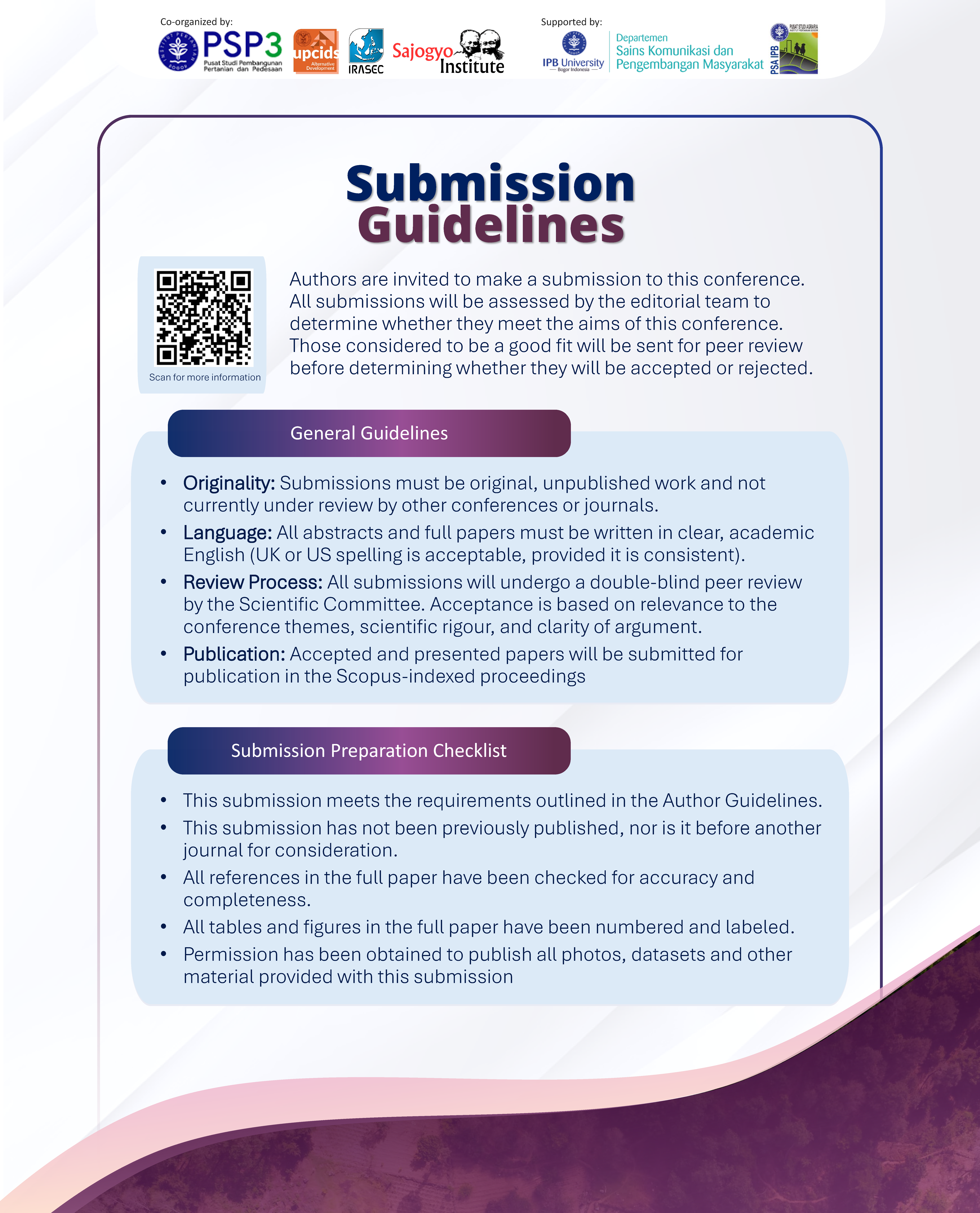
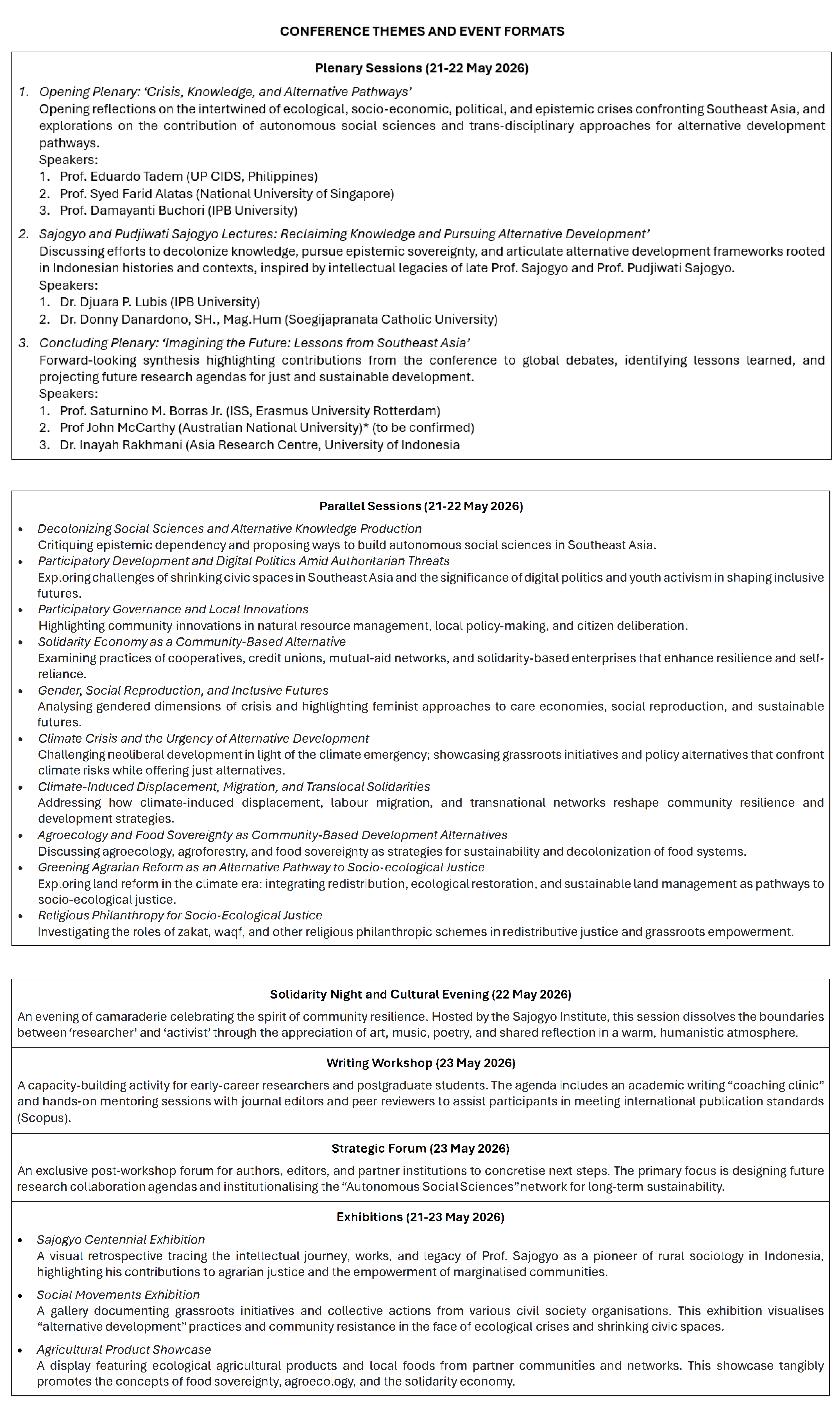
Organised by PSP3 IPB University, this event represents a strategic alliance with the Program on Alternative Development (AltDev) at the University of the Philippines, the Institut de Recherche sur l’Asie du Sud-Est Contemporaine (IRASEC) in Thailand, and the Sajogyo Institute. We invite scholars, activists, and policymakers to join a transdisciplinary dialogue that moves beyond technical solutions to climate change. Through plenary debates, parallel thematic sessions, and exhibitions showcasing social movements and agroecological innovations, the conference seeks to elevate marginalised knowledges and generate tangible scholarly outputs, including Scopus-indexed proceedings, that influence both academic infrastructures and policy sectors.
A Hybrid Platform for Collective Action
To maximise international participation while minimising our carbon footprint, the conference will be held in a hybrid format—combining offline engagement at the IPB University Dramaga Campus with a professional online streaming platform. Beyond the academic discourse, the programme features a Writing Workshop for early-career scholars and a Strategic Forum to institutionalise long-term regional collaboration. We invite you to be part of this crucial platform to assert agency over our collective futures, ensuring that our response to the poly-crisis is defined by pluralism, intellectual sovereignty, and social justice.
Conference Posters